Modular vs Hardwired Power Systems for Retail

Table of Contents
What Modular Power Systems Are
What Hardwired Power Systems Are
Modular vs Hardwired: Key Differences
Commercial Electrical Installation Costs
Retail Electrical System Maintenance and Reliability
Retail Store Power Outage Prevention Strategies
Which System Is Right for Your Retail Store
Frequently Asked Questions
Last Updated: October 10, 2026
What Modular Power Systems Are
A modular power system is an electrical infrastructure design where power distribution uses plug-and-play connectors and standardized wiring harnesses that can be easily reconfigured, added, or removed without cutting or rewiring permanent circuits. The choice between modular vs hardwired power determines how flexibly retailers can adjust distribution points as store layouts change, equipment is relocated, or new fixtures are installed.
Modular power systems excel in retail environments where flexibility matters. Store refreshes, seasonal displays, and equipment relocations happen regularly. With modular connectors, you can move a power connection from one point to another in minutes rather than hours. The system uses standardized connector types, allowing technicians to swap components quickly and safely.
These systems reduce installation labor since much of the wiring work happens off-site or during initial deployment. Technicians assemble harnesses and test connections before installation, then connect pre-built modules on-site. This parallel workflow cuts total project time compared to running individual circuits through walls and conduit.
What Hardwired Power Systems Are
A hardwired power system is a traditional electrical infrastructure where individual circuits are permanently wired directly into junction boxes, panels, and outlet locations using continuous conductors run through conduit or in-wall. Once installed, hardwired circuits cannot be easily reconfigured without cutting wires, installing new conduit, and obtaining electrical permits for modifications.
Hardwired systems have been the standard for decades because they're proven, reliable, and code-compliant when installed correctly. Every circuit is traced, documented, and sealed. The continuous conductor from the panel to the outlet eliminates connection points where failures can occur.
However, hardwired systems create inflexibility. Changing a power outlet location or adding a new circuit requires electricians to run new wire through walls, ceilings, or conduit. Store renovations that involve moving fixtures often trigger expensive electrical rework. The system is designed for permanence, not adaptation.
Modular vs Hardwired: Key Differences
When comparing modular vs hardwired power, the core difference lies in reconfiguration speed and installation approach. Modular systems prioritize flexibility through standardized connectors; hardwired systems prioritize permanence and proven reliability through fixed circuits.
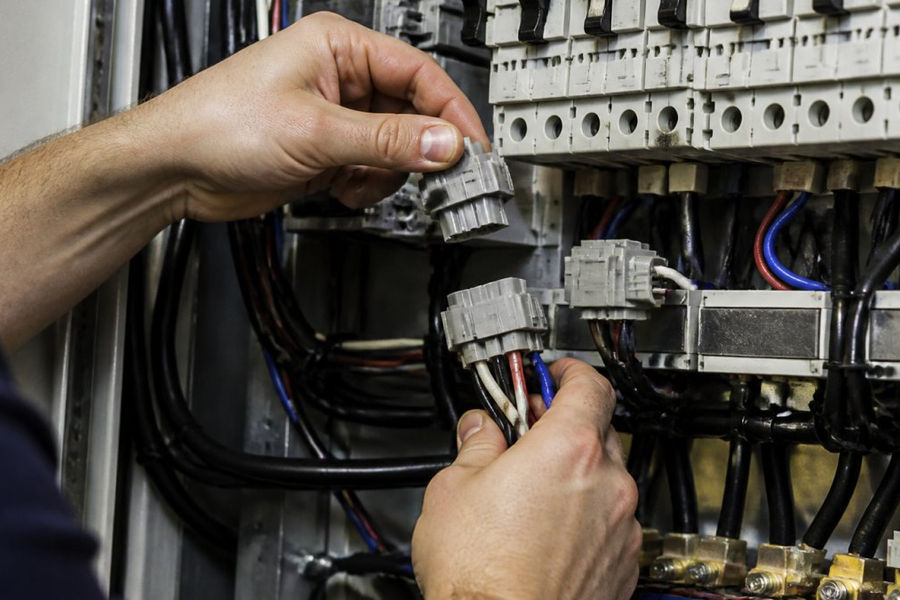
Installation labor differs significantly. Modular systems reduce on-site labor because much assembly happens beforehand. Hardwired systems require electricians to run continuous conductor through conduit, test each circuit, and seal connections, a more time-intensive process on-site.
Cable management also diverges. Modular systems use pre-assembled harnesses with defined routing, making cable organization predictable and neat. Hardwired systems require more custom routing based on building structure, often resulting in more complex conduit layouts.
Maintenance and troubleshooting show another key distinction. Modular connectors allow technicians to isolate and replace failed connection points quickly. Hardwired systems require tracing the continuous conductor along its entire path to locate faults, which takes longer.
Scalability matters for growing retail operations. Adding new power distribution points with modular systems involves connecting additional harnesses. Adding circuits to hardwired systems means running new wire, which is disruptive and costly during business hours.
Commercial Electrical Installation Costs
Installation costs for retail electrical systems break down into three categories: materials, on-site labor, and reconfiguration costs over the system's lifecycle. Modular systems typically show lower on-site labor because assembly and testing happen off-site, reducing technician hours at your location.
Material costs vary significantly by scope. Modular systems use standardized connectors and pre-fabricated harnesses, which reduce material waste and simplify inventory. Hardwired systems use continuous conductor, conduit, junction boxes, and fittings; costs depend heavily on building layout, circuit count, and whether existing conduit can be reused.
The real cost difference appears during store renovations and equipment changes, the hidden lifecycle costs that most retailers underestimate. Consider a grocery store that refreshes its produce section every three years. With a hardwired system, moving refrigeration units, adding new display lighting, or relocating checkout lanes requires:
Electrician labor to run new circuits
Conduit materials and installation
Electrical permits and inspection fees
Potential store closure or after-hours work to avoid customer disruption
Equipment downtime during installation
A modular system allows the same reconfigurations by swapping harnesses and connectors, work that can often be completed in hours rather than days, sometimes by trained facility staff rather than licensed electricians, depending on local electrical codes.
Operational disruption costs are often larger than material and labor combined. A grocery store losing sales during an electrical renovation might lose revenue, depending on store size and traffic. A boutique retail location might close entirely for a day, losing all daily sales. Modular systems reduce this disruption by enabling faster reconfiguration and, in some cases, allowing work during off-hours without full store closure.
Total cost of ownership over five years typically favors modular systems in retail environments with planned layout changes, and hardwired systems in stable, single-location operations with minimal equipment relocation. A boutique with a fixed layout and no planned expansion may incur costs for hardwired installation and minimal modification.
When evaluating bids, ask contractors to itemize not just installation labor and materials, but also estimated costs for a typical store refresh in year two and year four. This reveals the true financial impact of your choice.
Retail Electrical System Maintenance and Reliability
Reliability in retail depends on system design and maintenance practices. Both modular and hardwired systems can achieve high uptime when properly installed and maintained. The difference lies in how quickly problems are diagnosed and fixed.
Modular systems isolate failures to specific connectors. If a connection point fails, you can swap that connector or harness segment without affecting other circuits. Downtime is measured in minutes. Hardwired systems require electricians to trace the continuous conductor along its entire run, test at multiple points, and locate the fault before repairs begin. Downtime can extend to hours.
Preventive maintenance differs too. Modular connectors should be inspected regularly for corrosion or loose connections, a quick visual check. Hardwired systems require load testing and insulation resistance checks at various points, which takes longer.
Environmental factors affect both systems. Moisture, temperature swings, and dust in retail environments can degrade connections. Modular connectors designed for retail use have sealed housings that resist contamination better than exposed hardwired connections in some installations.
Retail Store Power Outage Prevention Strategies
Power outages in retail stop sales, disable security systems, and damage customer experience. Prevention requires redundancy, monitoring, and rapid response capability.
Circuit capacity planning prevents overloads. Calculate total electrical load for all equipment, displays, and HVAC systems. Ensure your power distribution system has headroom, never run circuits at 100% capacity. Modular systems make it easier to add capacity because you can connect additional power distribution points without rewiring. Hardwired systems require new circuits, which means more conduit and more installation time.
Surge protection matters in retail. Power spikes from external sources or equipment cycling can damage sensitive systems. Install surge suppressors at the main panel and at critical equipment locations. Modular systems allow you to add surge protection at specific connection points easily. Hardwired systems require surge suppressors to be wired into the circuit, which is less flexible.
Monitoring systems alert you to problems before they cause outages. Real-time electrical monitoring tracks voltage, frequency, and load across your circuits. If a circuit approaches capacity or shows abnormal voltage, you can shift loads or schedule maintenance before failure occurs.
Backup power planning protects critical systems. Identify which circuits must stay live during an outage: security systems, refrigeration, payment processing. Plan for portable generators or battery backup systems that can power these circuits if the main supply fails.
Which System Is Right for Your Retail Store
Your choice between modular and hardwired systems depends on five measurable criteria: layout change frequency, circuit load variability, installation constraints, expected service life, and operational disruption tolerance. Use this framework to evaluate your specific retail environment.
Layout change frequency: How often do you relocate fixtures, displays, or equipment?
High frequency (quarterly or more): Modular systems. Seasonal retailers, pop-up shops, and stores with rotating displays benefit from quick reconfiguration without electrician callbacks.
Low frequency (every 3+ years or never): Hardwired systems. Single-location boutiques, anchored grocery stores, and fixed-format operations justify the upfront cost of permanent wiring.
Medium frequency (annually): Hybrid approach. Use hardwired base distribution to the main panel, then modular connectors for fixture-level power. This balances stability with flexibility.
Circuit load variability: Do your power demands change as equipment is added, removed, or upgraded?
High variability: Modular systems allow you to add capacity by connecting additional distribution points without rewiring existing circuits.
Stable loads: Hardwired systems, sized for current and foreseeable future demand, are cost-effective and reliable.
Installation constraints: What are your building and operational realities?
Existing conduit or limited wall access: Modular systems reduce the need for new conduit runs and can work within existing infrastructure more flexibly.
New construction or full renovation: Hardwired systems are often cheaper to install during new construction because the building is already open.
Cannot close during installation: Modular systems enable faster, often off-hours installation with less operational disruption.
Must minimize after-hours work: Hardwired systems, once installed, require no ongoing technician visits for routine reconfigurations (though modifications still require electricians).
Expected service life: How long do you plan to occupy this location or maintain this store format?
5+ years with stable layout: Hardwired systems. The longer you stay, the more the upfront cost is amortized.
3-5 years with planned changes: Modular systems. Reconfiguration costs are lower, and the system adapts to your evolving needs.
Uncertain or short-term (pop-up, lease expiration): Modular systems. Flexibility protects your investment if plans change.
Operational disruption tolerance: How much can your store afford to be closed or partially offline?
Zero tolerance (grocery, pharmacy, high-traffic retail): Modular systems. Faster installation and reconfiguration mean less lost sales.
Moderate tolerance (boutique, specialty retail): Either system works; weigh cost against convenience.
High tolerance (warehouse, back-of-house only): Hardwired systems. Cost savings outweigh convenience since disruption is acceptable.
Store format considerations:
Large-format retail (50,000+ sq ft): Hardwired base distribution with modular fixture connections. The scale justifies permanent infrastructure, but fixture flexibility is essential.
Grocery stores: Modular for produce, dairy, and checkout areas (frequent resets); hardwired for HVAC and refrigeration (stable loads).
Boutique or specialty retail: Hardwired if layout is fixed; modular if seasonal displays or merchandise rotation is planned.
Multi-unit chains: Modular standardization across locations reduces training time and accelerates deployment in new stores.
Pop-up or temporary retail: Modular systems exclusively. Portability and quick setup are non-negotiable.
Decision checklist:
Score your store on each criterion (1 = favors hardwired, 3 = neutral, 5 = favors modular). If your total is 15 or higher, modular systems likely deliver better value. If your total is 10 or lower, hardwired systems are the better choice. Scores between 10 and 15 suggest a hybrid approach.
Once you've identified your system type, consult with a retail electrical contractor who can assess your specific building, local electrical codes, and operational constraints. Proper installation and code compliance are non-negotiable regardless of which system you choose.
Frequently Asked Questions
What is the difference between modular and hardwired power systems?
Modular power systems use plug-and-play connectors and wiring harnesses that allow circuits to be reconfigured without rewiring. Hardwired systems feature fixed, continuous conductors soldered or crimped directly into place. Modular systems offer greater flexibility for layout changes and expansions, while hardwired systems provide permanent, lower-line-loss connections. For retail, modular systems simplify fixture relocation during store refreshes, whereas hardwired systems reduce connection points and potential failure sources.
Are modular power systems a good choice for retail stores?
Modular power systems work well for retail stores planning frequent layout changes or fixture updates. They reduce installation labor and downtime during remodels, and allow easier scalability as electrical load demands grow. However, they require more maintenance due to additional connection points. Hardwired systems suit retail operations with stable layouts and higher reliability requirements. The choice depends on your store's expected lifespan, remodel frequency, and tolerance for reconfiguration.
Can modular and hardwired systems be used together in a retail store?
Yes, many retail installations use a hybrid approach. A hardwired backbone distribution system carries power to key areas, while modular connector systems branch off to individual fixtures and equipment. This strategy combines the reliability and low line loss of hardwired main circuits with the flexibility of modular connections for retail fixtures. This semi-modular design balances installation labor, maintenance complexity, and operational flexibility for retail environments.
Which system reduces retail store power outage risk more effectively?
Hardwired systems typically have lower outage risk because they eliminate modular connection points where failures can occur. Fewer connections mean fewer troubleshooting variables during electrical faults. However, modular systems reduce downtime during maintenance because individual circuits can be reconfigured without affecting the entire power distribution network. For outage prevention in retail, prioritize circuit capacity planning, redundant power supply paths, and regular maintenance regardless of system type. Professional electrical assessment ensures your system matches your store's critical load requirements.
Request a Quote

Comments