Retail Track Lighting Alternatives: 2026 Comparison Guide

Table of Contents
Why Retailers Are Rethinking Traditional Track Lighting
The Alternatives at a Glance: Comparison Table
Magnetic Track Lighting for Retail: The Flexible Upgrade
Where Magnetic Systems Beat H-Style Track
Retail Recessed Lighting: A Clean Ceiling Look
Retrofit Constraints and Wiring Requirements
Linear LED Lighting for Retail Stores: Continuous, Even Illumination
Retail Display Lighting Ideas Beyond Track Heads
Performance Metrics, Controls, and Total Cost of Ownership
Retail Lighting Performance Metrics That Actually Matter
Controls and Interoperability
Total Cost of Ownership: A Line-by-Line View
How to Choose: A Selection Framework for Your Store
Step 1: Classify the Space
Step 2: Check Retrofit Constraints
Step 3: Confirm Compliance and Safety
Step 4: Score the Alternatives
Frequently Asked Questions
Last Updated: October 18, 2026
Why Retailers Are Rethinking Traditional Track Lighting
Retail track lighting has been the default for decades, but store managers evaluating retail track lighting increasingly seek alternatives.
We install and service commercial lighting across North Carolina, and the pattern is consistent: retailers want lighting that adapts as fast as their merchandising plan. Below, we compare the alternatives and how to choose based on layout, budget, and control needs.
Key Takeaway The best alternative depends less on fixture style and more on how often your layout changes. High-change stores should prioritize reconfigurability; stable layouts can favor recessed or linear solutions.
The Alternatives at a Glance: Comparison Table
Magnetic track lighting is the most flexible upgrade, recessed lighting the cleanest, and linear LED the most even. Each trades off differently on installation effort, flexibility, and upfront cost.
Alternative | Layout Flexibility | Installation Effort | Best For |
Magnetic track lighting | High | Moderate to high | Stores that reconfigure displays often |
Retail recessed lighting | Low | High (ceiling work) | Clean ceilings in permanent layouts |
Linear LED lighting | Medium | Moderate | Aisles and walls needing even light |
Display-specific fixtures | Medium | Low to moderate | Feature tables and focal displays |
Magnetic Track Lighting for Retail: The Flexible Upgrade
Magnetic track lighting for retail is a low-voltage system where fixtures attach magnetically to a slim rail, so heads and pendants move without tools. Staff can reposition a spotlight in seconds when a display changes; the rail mounts flush or suspended depending on ceiling type.
Where Magnetic Systems Beat H-Style Track
Magnetic systems beat H-style track on fixture size, repositioning speed, and design flexibility. H-style track uses mechanical locking tabs and larger heads, limiting how close fixtures sit; magnetic rails carry smaller, lower-profile heads and accept pendants, linear modules, and spotlights on one rail.
The trade-off is cost and compatibility. Magnetic systems are proprietary, so fixtures from one brand usually will not fit another brand's rail. Plan for a single-vendor system and confirm driver and control compatibility before purchase.
Watch Out Mixing magnetic rails and fixtures from different manufacturers is a common mistake. Proprietary connectors mean mismatched parts often will not seat correctly, and returns are rarely covered once the rail is installed.
Retail Recessed Lighting: A Clean Ceiling Look
Retail recessed lighting is a fixed downlight set into the ceiling and delivers the cleanest visual result of any alternative. With no visible rails or heads, it suits high-end apparel, jewelry, and any store where the ceiling should disappear.
The limitation is permanence. Once a recessed light is placed, moving it means cutting new ceiling openings and patching old ones. For stable layouts that is a fair trade; for stores that rearrange seasonally, it becomes a recurring cost.
Retrofit Constraints and Wiring Requirements
Retrofitting recessed lighting is the hardest part: it requires ceiling access, new junction boxes, and often new circuits. In older buildings, existing wiring may not handle the fixture count a modern layout needs.
Before committing, have an electrician verify circuit capacity and ceiling cavity depth. Some ceilings cannot accommodate the housing depth required, which rules out recessed fixtures entirely.
Linear LED Lighting for Retail Stores: Continuous, Even Illumination
Linear LED lighting for retail stores runs in continuous strips or suspended runs, producing an unbroken band of light instead of a series of pools. That evenness matters in aisles and wall displays, where shadows and hot spots make merchandise harder to evaluate.
Linear runs mount to ceilings, walls, or shelving and can be specified in different color temperatures and output levels.
Option | Reconfiguration Speed | Visual Result | Relative Cost |
Magnetic track | Fast, tool-free | Flexible, visible fixtures | Higher upfront |
Recessed | Slow, ceiling work | Clean, hidden | High installation |
Linear LED | Moderate | Even, continuous | Moderate to high |
Retail Display Lighting Ideas Beyond Track Heads
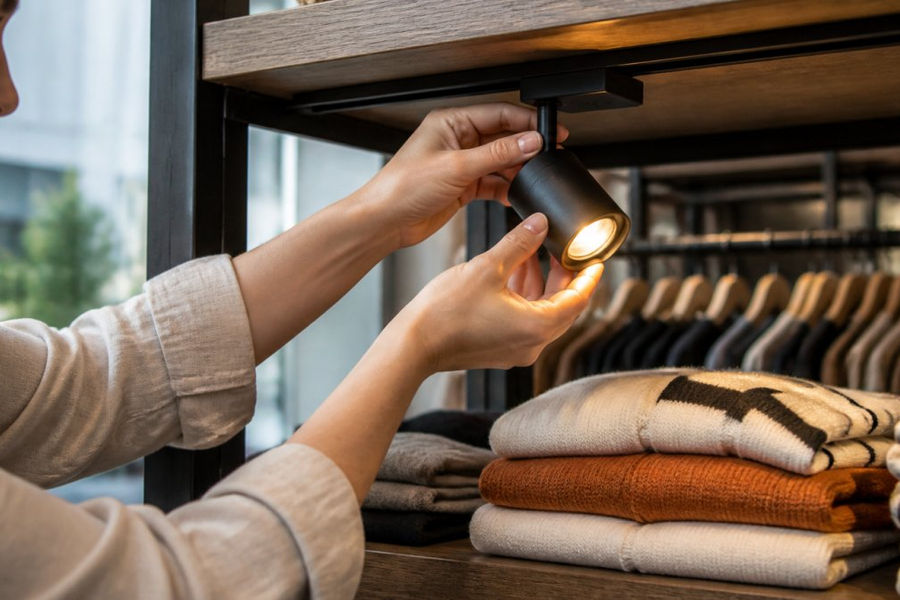
The right mix depends on what the display needs to do. Ambient lighting sets overall brightness, accent lighting pulls attention to specific products, and task lighting supports close inspection at counters.
Pro Tip Place accent fixtures at roughly a 30-degree angle to the merchandise rather than straight down. Angled light reveals texture and reduces the flat, washed-out look that overhead-only lighting produces.
Performance Metrics, Controls, and Total Cost of Ownership
Judging a lighting system on fixture price alone hides both real cost and real performance. The alternatives differ as much in measurable light quality and lifecycle economics as in appearance. Here are the numbers to compare them on equal footing.
Retail Lighting Performance Metrics That Actually Matter
Four metrics drive how merchandise looks and how a store feels. Ask every vendor for these values in writing before comparing quotes.
Illuminance (footcandles). The amount of light landing on a surface. General circulation areas commonly target roughly 10-20 footcandles, feature displays and POS counters 50-100 or more, and high-end jewelry cases several hundred on the product itself. Treat these as starting ranges, not code minimums, verify against your local energy code and IES recommended practices.
Uniformity. The ratio of minimum to average illuminance across a display. A low ratio means hot spots and dark gaps; a high ratio means even light. Linear LED and recessed grids generally beat spaced track heads, which is why aisles and wall runs favor them.
Color rendering (CRI and TM-30). CRI above 90 is a common retail baseline; below 80, reds and skin tones look dull and returns rise. TM-30 (Rf and Rg) gives a fuller picture. For apparel and cosmetics, specify high R9 (deep red) explicitly, many fixtures score well on average CRI but poorly on R9.
Pro Tip Ask for a photometric layout (IES file) for your actual ceiling height and fixture spacing. A fixture that looks strong on a spec sheet can underperform once spacing and mounting height are applied. Controls and Interoperability Controls decide whether a good lighting design stays good after opening day. The main levers are dimming, zoning, occupancy sensing, daylight harvesting, and scene control. Request a Quote → Dimming protocol. 0-10V is the most common commercial interface and widely supported; DALI offers addressable, fixture-level control but needs compatible drivers and commissioning; TRIAC/phase-cut often causes flicker or limited range on commercial LED drivers. Confirm the driver's dimming range (e.g., 1% vs. 10% low end), a 10% floor is fine for housekeeping but too bright for a dimmed evening scene. Sensors and scenes. Occupancy and vacancy sensors cut energy in stockrooms and fitting rooms; daylight sensors near storefront glazing trim output when sun contributes. Scene control lets staff switch between open, event, and close modes without touching individual fixtures. Interoperability. If the store has or plans a building-management system, confirm controls speak a standard protocol (e.g., DALI, 0-10V, or a documented API) rather than a closed app-only ecosystem. Proprietary magnetic-track controls are a common trap: rail and app may be tied to one vendor for the life of the install. The U.S. Department of Energy guidance on lighting controls explains how control strategies affect energy use, and the DOE solid-state lighting program covers LED performance testing and color metrics. Total Cost of Ownership: A Line-by-Line View TCO is where the alternatives separate most sharply. Build a five-year model with these lines rather than comparing sticker prices: Cost line Magnetic track Recessed Linear LED Fixtures and rail/housing Higher per head; proprietary Moderate per fixture; many units Moderate to high per run Installation labor Moderate to high (rail, drivers) High (ceiling cuts, patching) Moderate (mounting, joining) Reconfiguration labor over life Low (tool-free moves) High (ceiling work each change) Moderate (re-specify runs) Energy Low (LED, dimmable) Low Low Maintenance and replacement Proprietary parts; single-vendor risk Access from below helps Long runs mean fewer drivers Controls Often vendor-locked Standard protocols common Standard protocols common The pattern most retailers find: magnetic track wins on reconfiguration labor and loses on upfront cost and vendor lock-in; recessed wins on appearance and loses on every layout change; linear LED sits in the middle but shines on long, stable runs where evenness and low driver count cut maintenance. For code and energy requirements, check the DOE building energy codes program before specifying a system. Local adoption varies, and confirming requirements early prevents redesigns later. A low fixture price can hide a high TCO. Proprietary magnetic systems, in particular, can lock you into one vendor's replacement parts and control app for the life of the install, price the second and third reconfiguration before you sign.
How to Choose: A Selection Framework for Your Store
Most competitor pages stop at "it depends on your layout." A usable framework goes further, tying the choice to ceiling type, wiring, lease terms, renovation scope, and code obligations.
Step 1: Classify the Space
Answer four questions before you look at fixtures:
Do you own or lease? In a leased space, reversible systems (magnetic track, pendant, surface-mounted linear) avoid ceiling penetrations your landlord may require you to restore at move-out. Recessed lighting is a permanent alteration and often needs landlord approval.
What is the ceiling? Exposed structure, drop ceiling (T-bar), drywall, or concrete all change what is feasible. T-bar grids accept lay-in linear and panel fixtures with minimal labor; concrete ceilings make recessed work expensive and favor surface or suspended systems.
What is the renovation scope? A fixture swap is a different project from a full build-out. If circuits and ceiling stay put, favor systems that reuse existing wiring; if the ceiling is open, recessed and linear become far more attractive.
How often does merchandising change? Monthly changes justify magnetic track's upfront premium; annual changes usually do not.
Step 2: Check Retrofit Constraints
Circuit capacity. Have an electrician verify the existing panel and circuit load before adding fixtures. LED retrofits often free capacity, but adding circuits is a cost line many quotes omit.
Ceiling cavity depth. Recessed housings need depth; shallow plenums and concrete slabs rule them out. Measure before specifying.
Wiring access. Surface and suspended systems minimize ceiling work; recessed and in-ceiling linear require access above.
Step 3: Confirm Compliance and Safety
Electrical code. Commercial lighting installations must comply with NFPA 70 (National Electrical Code); confirm the installer is licensed and permits are pulled where required.
Energy code. Commercial lighting power allowances are set by state and local adoption of the energy code; check the DOE building energy codes program for your jurisdiction before finalizing a design.
Emergency and egress lighting. Exit signs and egress illumination are separately regulated and must remain functional regardless of which decorative or display system you choose.
Step 4: Score the Alternatives
Use this decision guide to narrow the field, then confirm with a photometric layout.
If your situation is... | Strongest fit | Why |
Leased space, frequent display changes | Magnetic track | Reversible, tool-free repositioning |
Owned building, permanent high-end layout | Recessed | Clean ceiling, stable appearance |
Long aisles or wall runs, stable layout | Linear LED | Even illumination, fewer drivers |
Feature tables and focal displays | Display-specific fixtures | Targeted accent without full rewire |
Open ceiling, full renovation | Linear or suspended track | Reuses structure, avoids ceiling work |
Classify space (owned/leased, ceiling type, scope)
Verify circuit capacity and ceiling cavity with an electrician
Confirm landlord approval if leased and penetrations are planned
If displays change monthly, magnetic track lighting usually wins despite the higher upfront cost. If the layout is fixed and the ceiling should stay clean, recessed lighting is stronger.
This is where professional specification pays off. We design code-compliant commercial lighting for retail environments, verifying circuit capacity, control compatibility, and installation requirements before any fixture is ordered.
Key Takeaway The framework is a filter, not a verdict. Two stores with identical merchandise can land on different systems because of lease terms, ceiling type, and how often the layout moves, decide those first, then compare fixtures.
Frequently Asked Questions
What are the best alternatives to traditional track lighting in a retail store?
The main alternatives are magnetic track lighting, recessed lighting, linear LED lighting, and monorail or cable-mounted fixtures. Magnetic systems keep the flexibility of track lighting but allow heads to be repositioned without tools and swapped between pendant, spotlight, and linear modules. Recessed lighting gives a cleaner ceiling, linear LED runs suit aisles and perimeter walls, and monorail fixtures work well over display tables. The right pick depends on ceiling type, how often your layout changes, and how much accent control your merchandise needs.
Can magnetic track lighting replace traditional retail track lighting?
Yes, in most retail settings magnetic track lighting can replace H-style, J-style, or L-style track. The key difference is compatibility: magnetic systems are proprietary, so heads and tracks must come from the same manufacturer, while traditional H, J, and L tracks follow common cross-brand standards. If your existing track is in good condition, you can often keep it and change heads. If you are rewiring or remodeling, a magnetic system gives more layout flexibility and cleaner fixture changes over time.
Is recessed lighting a good alternative to track lighting in stores?
Recessed lighting works well when you want a clean ceiling and even ambient light, such as over aisles, fitting rooms, and checkout areas. It offers less directional control than track heads, so it pairs best with accent fixtures for merchandise. The main constraint is installation: recessed cans require cutting into the ceiling, running new wiring, and often adding a new circuit, which costs more than swapping track heads. In leased spaces, check whether your lease allows ceiling penetrations before committing.
How do you light retail displays without track lights?
You can light displays with recessed adjustable downlights, linear LED strips tucked into shelving or cove details, monorail fixtures suspended over tables, or small spotlights mounted on cable systems. For mannequins and feature tables, narrow-beam accent fixtures at 3000K to 3500K with a color rendering index of 90 or higher keep merchandise colors accurate. Layer ambient, accent, and display lighting rather than relying on one source, and put everything on dimmers so you can adjust brightness for day and evening trading.
Retail lighting decisions get expensive when they are made on fixture price alone. The right system depends on your layout, your ceiling, and how often your displays change. Elecstroman Electric brings code-compliant electrical engineering and commercial installation experience to retail projects of every size, with strict adherence to technical specifications and safety protocols. Request a quote and get a lighting plan built around how your store actually operates.
Request a Quote

Comments